
Bringing value-based procurement to the NHS
DEPARTMENT OF HEALTH AND SOCIAL CARE


The Department of Health and Social Care (DHSC) is a UK government department responsible for setting health policy and improving the capability, efficiency and safety of the NHS.
As part of the MedTech Strategy and the 10 Year Health Plan, DHSC’s Medical Technology directorate is seeking to drive a shift from evaluating NHS procurements solely on cost towards ‘value-based procurement’ to centrally improve patient safety and enable higher quality care through access to and use of medical devices.
The challenge
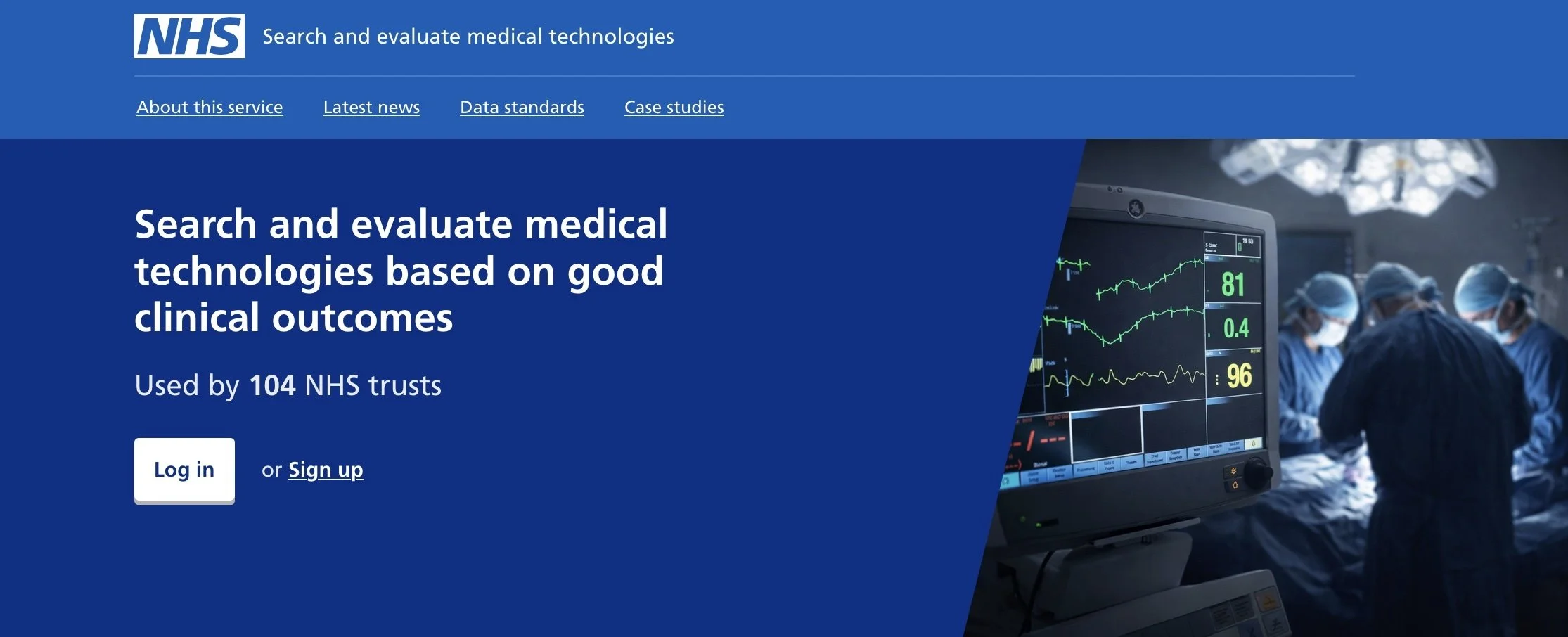
To understand what issues were preventing the adoption of value-based procurement, DHSC conducted a comprehensive Discovery phase in March 2025. The Discovery found that major pain points for NHS procurement staff are:
Lack of access to trusted information about which medical devices perform best.
Lack of consistent information sharing between Trusts, resulting in duplicative product evaluations and procurement lessons not being learned by the whole healthcare system.
The recommendations from the Discovery were thus to develop a product value information service to address unmet information needs and to improve the culture of sharing of data between Trusts, currently done informally through professional networks.
To address these pain points, the DHSC established the MedTech Compass project. Policy-makers envisioned a comprehensive, centralised database to aid with value-based procurement. More specifically, they conceptualised a "Which?" guide for medtech to provide trusted, consistent product evaluations. They made an assumption that this service would need to include data from centrally recognised sources like the National Institute for Clinical Excellence (NICE) and the Orthopaedic Data Evaluation Panel (ODEP), recognised accreditations like DTACs and evaluations shared by NHS trusts.
But it wasn't clear whether primary users would adopt such a digital database as a way to support value-based procurement and drive behavioural change. They needed a multidisciplinary team that brought user-centred design and data expertise together for an Alpha phase. The team would need to check DHSC's key assumptions and lay the groundwork for full digital delivery of a new service.
What we did
Defining the strategic direction
“It was clear that Register Dynamics brought genuine expertise across all areas of the Alpha. I felt very confident in the team’s technical, research and design capabilities.”
DHSC engaged Register Dynamics to undertake the Alpha phase of the project, in partnership with Oxford Insights. We established and led a senior multidisciplinary team including user research, service design, interaction design, business analysis, technical architecture and data architecture disciplines. We planned and undertook a 17-week Alpha phase to fully explore the feasibility of the MedTech Compass and test service designs that DHSC could have confidence in building fully in a Beta phase.
Such an undertaking presents considerable challenges in terms of user-centred design and data management. We first had to conduct extensive user research to understand user needs and build a prototype that met those needs whilst also meeting GDS design standards. In conjunction with that we needed to understand in detail the existing data landscape – how data is stored and structured across multiple organisations and what the common identifying IDs or data fields would be.
By speaking with clinicians and procurement professionals in one-to-one interviews, we set out to learn more about Trust-to-Trust sharing and understand specific information needs. These sessions revealed key insights that helped us form our service vision:
that users often struggle to interpret highly clinical evidence from central sources
that users gain confidence when they have access to real-world experience
that they seek this information from peers who may have inside knowledge of specific medical trials or procurement processes
that they need help discovering the products their peers are using, reviewing trials, and making contact.
We developed user personas based on this research, each with their own, more specific pain points and user needs, and began to design a service prototype that would address them.
We realised that whilst the initial focus had been on highly trusted data from central sources, the most valuable data that users didn’t have access to was held in the trials, business cases and case studies produced by Trusts and in the heads of NHS staff with direct product experience. Compass would need to not only surface and centralise this written evidence but also facilitate conversations and proactive sharing between NHS peers.
Evaluating the data
A key aspect of the problem was data. We did research and engagement to understand the existing data structures in use within the NHS and other organisations. This enabled us to understand what information evaluations would contain and how we would need to design the Compass data architecture. We also engaged with DHSC’s IT team to understand the existing technological systems that they had in place which helped inform and guide how we would build our own. The proposed architecture took the form of a hybrid data lake and database system, with the raw evaluations being stored in a directory within DHSC’s existing data lake and a PostgreSQL database containing the evaluation metadata, the product catalogue and list of matches of evaluations to products.
For data matching, we identified what the best ways of matching would be. The ideal was user-designated, where users (e.g. NHS Trust procurers) would select the correct product and upload their evaluations for that product. This fed into wider user research around suppliers. They were initially not considered to be a key user but through user research we established they were a key user and would be highly motivated to understand how their products were being evaluated, and a potential source of adoption.
However, for bulk data imports of evaluations from third party organisations, we would need to match either on a common identifier. We were able to source a catalogue of MedTech products themselves from MHRA data and DHSCs ongoing PIM (Product Information Management) service (which is being developed alongside Compass). These provided two clear candidates for product identifiers: UDI numbers and Manufacturer Product Codes, though each comes with difficulties. UDI number is a relatively new development, and whilst it is becoming mandatory for all new products, among existing products the proportion with a UDI number is woefully low (around 40%), and it is not commonly in use among organisations that we would need to source evaluations from. MPC is much more complete (over 80% of products), and is commonly in use with other organisations, but there are risks of duplication of MPCs between manufacturers, creating complications that we would need to account for.. Where neither of these options were available, we would need to attempt product matching based on product and manufacturer names. These fields often do not match exactly across different systems so we would need to identify the closest matches and these would need to be moderated to find the correct one. To address this we did initial research into fuzzy string matching and used our findings to make recommendations that could be built upon in beta.
This research into data matching in turn influenced the service design. Given the much greater reliability of user matching over machine matching, we sought ways to expand the scope of user matching, and discovered an increased role for suppliers. We could identify potential matches using fuzzy matching and then have suppliers review and either confirm or correct which assessments matched with their products.
User research
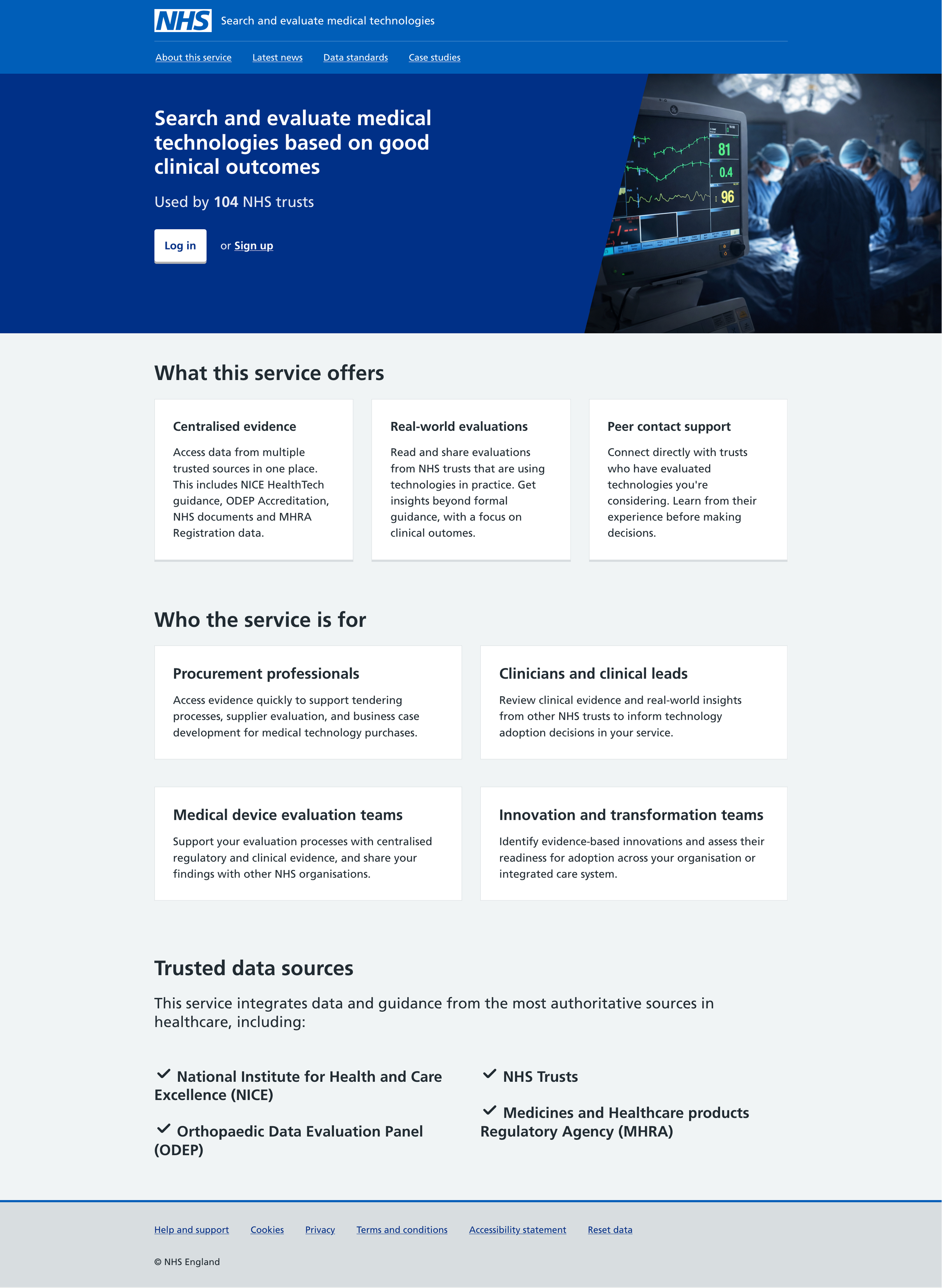
Alongside ensuring data was available and reliable, we needed to design a simple accessible way to surface it to users. Across 27 usability testing sessions, we tested our assumptions and gathered qualitative feedback that informed several prototype iterations. Feedback influenced updates to both copy and structure.
For example, user confusion about homepage CTAs led to one clear call-to-action at the top of the page and elimination of a section and image referring to the NHS 10-year plan. In response to concerns about text density, we stripped back the copy across several of the pages in the prototype to reduce overwhelm. When we learned that words like “trial” and “evaluation” had highly specific connotations for some users that did not match their meaning in the service, we found context-based solutions to disambiguate. Modes of searching, various presentations of search results and shared trust experiences, and prompts to incentivise sharing were among the other elements we tested.
Through sessions with people with disabilities, including several who used assistive technologies, we identified additional content updates that would help make the service more accessible (like making sure product information cards were displayed in a single column and that anchor links were sparsely and correctly used).
User research also informed plans for further research and content design and user experience updates in beta.
Data screening
Trust in the information available through the service is essential to continued use and increased adoption of the service." Risks involved in collecting and surfacing inaccurate or outdated information included:
Trusts might not want to use it or can’t because it could make them responsible for outdated information, which frustrates data providers who feel their work isn’t making a difference and so they stop using the service.
Trusts that do reuse the information might not be safe or proper (for example, reusing a local risk assessment from another Trust in a way that saves them time but doesn’t correctly address their local risks), so Compass isn’t really encouraging better ways to get information.
In order to avoid this, our team developed a Data Screening Process that ensured that the data in Compass would be valuable and trusted. This process asks 20 questions across 5 gates:
Context & Scope filters out sources that don’t relate to MedTech products, don’t address a user need, or are still in the ideation stage.
Trustworthiness & Quality validates that data is trusted through recognised expertise, and can’t be used in unsafe ways by users.
Legal & Commercial Viability assesses compliance with data privacy and copyright laws, value for money, and risk from subjective information.
Implementation & Prioritisation covers how the dataset will be linked and kept up to date, and how the service will be involved in ongoing management.
User Validation: Final user research with service users to prove value.
We've developed the process by drawing on our earlier data standards work, where we considered everything that users need to know about a dataset and why.
The result
“You provided an outstanding service, achieved a Green Rating at the Service Assessment, and produced a clear and detailed handover report.
The professionalism, intellect and expertise brought by Register Dynamics have put the project in a fantastic position.”
Our team outlined the full scope of the challenge, and applied expertise in data, service design, content design and business analysis to solve a whole problem and iterate, not just fixing the data and content separately and leaving the underlying complications untouched.
Our refined vision for the MedTech Compass at the end of Alpha is for a service that could provide MedTech evaluations, business cases and case studies that clinicians and procurement specialists across the NHS can use to help them choose the best products. Evaluations will be provided by Trusts sharing their own assessments of MedTech products, so Compass will also establish a culture of sharing data and outcomes about procurements amongst Trusts. Compass will also centralise trusted evaluative information from other bodies such as NICE or ODEP where there is a clear user need for the data.
We had a well developed interface with multiple rounds of user testing. We also had a well developed design of both the technical and data architecture, with a good understanding of the nature of the data and the data flows through the system. We identified key areas to investigate in beta (such as fuzzy matching).
The end result was a highly successful alpha phase of the Compass project which provided strong foundations that could be built on in beta. We passed the GDS Alpha service assessment with a green rating in all assessment categories. Our assessors said we were an "exemplar" team and congratulated us on passing first time, with no serious concerns.
Tags: