
Simon is co-founder of Register Dynamics and is a highly skilled technologist, engineer and data architect. He specialises in building better interfaces between humans and data and is a leading expert in emerging data technology.
He has over 10 years experience leading, mentoring and inspiring teams to develop new products, perform pioneering research and to create cutting edge data infrastructure.
His career
Simon has been at the forefront of data technology and innovation for over a decade. He has held roles from Data Architect to Head of Data Architecture to Chief Data Officer and is considered a visionary when it comes to the future of data and distributed data systems.
Since graduating with a First Class Honours from Imperial College, London, his career has progressed rapidly. He has worked within various UK Government departments and in the private sector often as the main forger of relationships between different teams, stakeholders and users.
He has briefed various Secretary of State and Ministers on emerging data issues, offered guidance and expertise to multiple cross-Government boards, and directed teams of researchers, designers, developers and policy stakeholders. Simon is well versed in handling complex environments and in supporting businesses both large and small with their data needs.
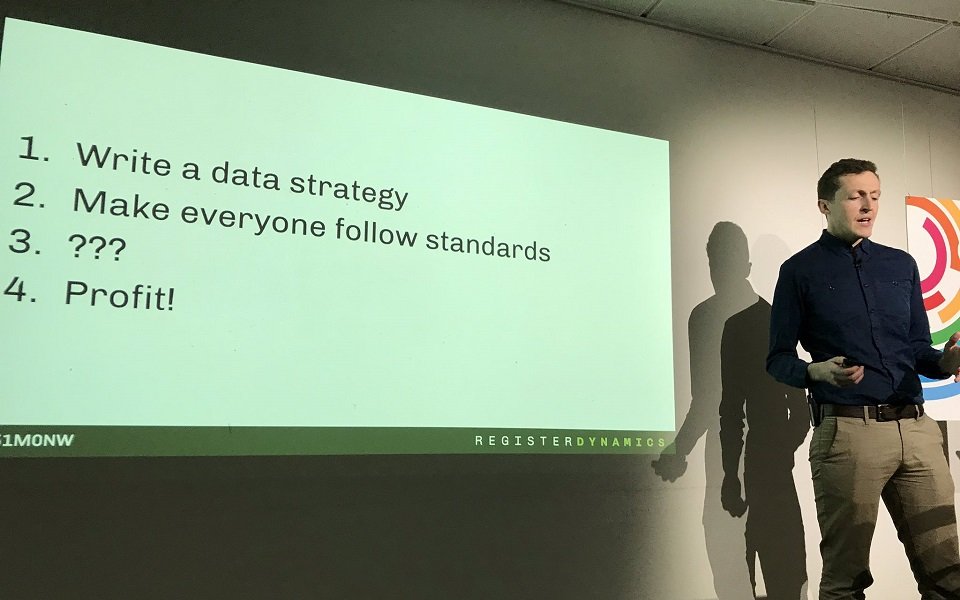
Simon’s wealth of knowledge makes him a popular speaker in the data and technology arena. He regularly shares his insight across a wide range of subjects including distributed data storage systems, WebAssembly, data architecture and personal data. Recent conferences include: Compute Over Data Summit, WASM - the WebAssembly Conference, Institute for Government Data Bites and Open Data Institute Friday Lectures
Simon’s work has been published and he is the lead author on the Office for AI Data Trusts Report on distributed ledger technology for data institutions, and the IEEE Software Open Data Publication, which investigates the use of open data sets and sharing version-controlled open data in government.
Simon is a Level Up mentor to disadvantaged up-and-coming software engineers and entrepreneurs in the Middle East
When Simon is not working he is most likely hiking, skiing, creating his latest embroidery masterpiece or cooking up some hot sauce.
Simon’s impact in government
Simon is a trusted senior data expert and leader with many years of experience working in government. His work in government has seen him as a Chief Data Officer, briefing Secretary of State and Ministers at the Department of International Affairs, on emerging data issues leading up to Brexit.
He led the time-pressured development and launch of the UK’s Tariff Management Tool - a vital new data management system for managing the UK’s applied trade tariff policy (a critical function which would otherwise have been lost post-Brexit).
Simon created a groundbreaking new data maturity model and framework for authoritative data management, supporting the Department of Environment, Food and Rural Affairs’ mission to improve its data maturity.
He pioneered a novel personal data sharing system called Personal Data Exchange - a key component in the Government Transformation Strategy for transforming online services for citizens.
What is Simon like to work with?
Simon is a commercially-minded business leader and manager. He has a direct and friendly approach to communication and is exceptionally good at getting things done.
Difficult tasks are made to look easy, and complex environments are handled with care and craftsmanship. Simon is the person everybody turns to when they need help and when they want something important done correctly.
Simon’s passion and energy drives him forwards and is infectious to others. He is a brilliant mentor and advisor and has the complete trust of all his colleagues and clients.
Simon’s publications


In this journal article published in IEEE Software, we describe the preliminary findings of an interview study investigating experiences with using open data sets from the U.K. government’s Department for International Trade and techniques used for sharing version-controlled open data.
In order to be able to offer compelling advantages, the control and enforcement powers that data trusts have needs to be high enough that misusing the data in trust is prohibitively difficult. By examining case studies in audit technology, we aim to show that cost-effective strong auditing is possible. Read the full report.
Simon’s articles













Simon’s talks
Simon’s guest posts